
Guangzhou Embroidery
Artforms > Guangzhou Embroidery

Commonly practised in Chaozhou City, Guangzhou embroidery (widely referred to as Cantonese embroidery) is a folk craft originating from the ancient territories of Nanhai, Panyu, and Shunde over 1,000 years ago. One key characteristic particular to Cantonese embroidery is the combination of materials – e.g., velvet, gold and silver thread embroidery alongside beaded embroidery (a more recent invention). Velvet embroidery holds the most extensive history within Cantonese embroidery, allowing the artist to be far more expressive with the material, as opposed to gold and silver.
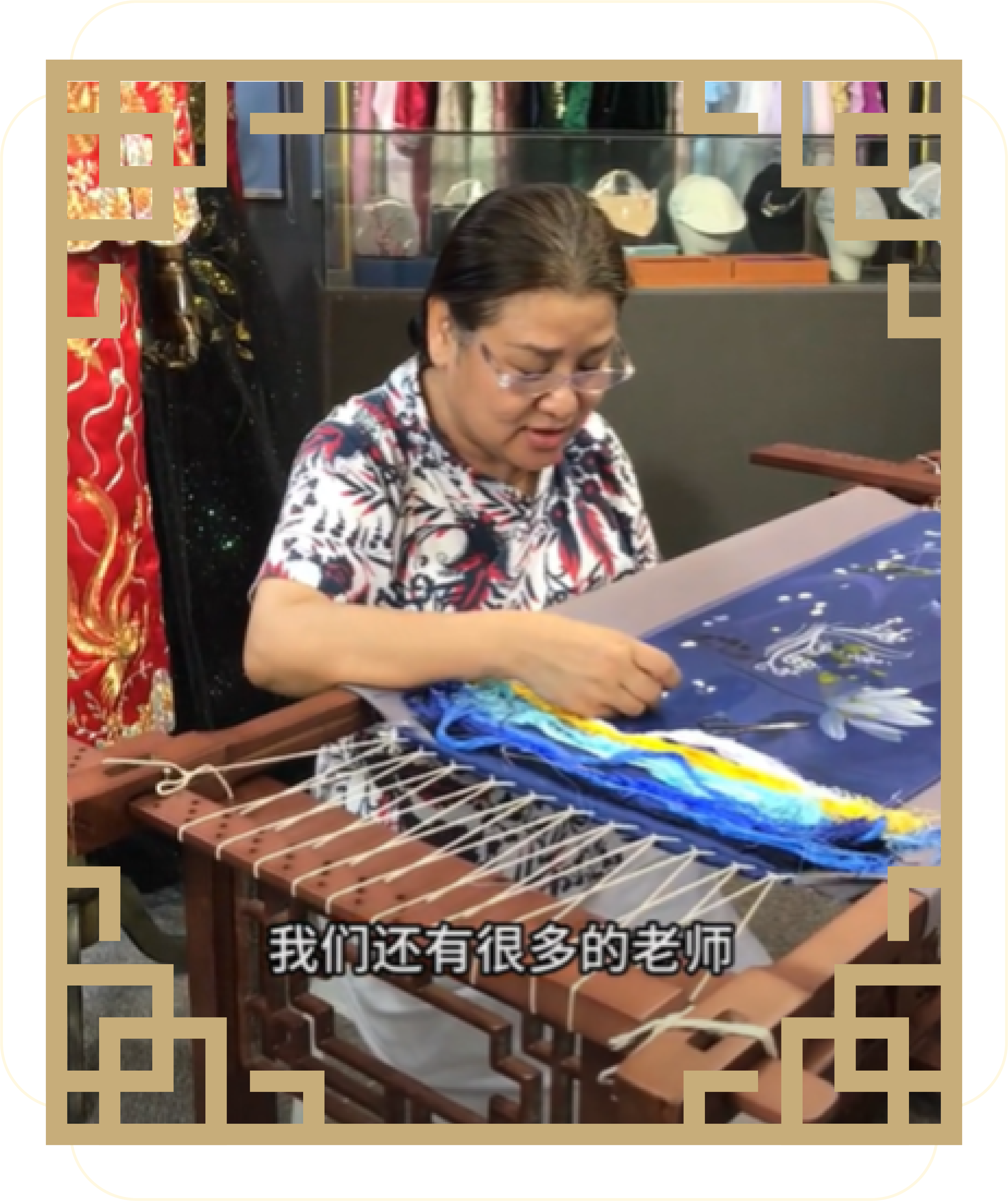
Tang Xiaoling, Working on one of her Cantonese Embroidery Pieces at her Workshop.

There are seven categories of embroidery: flat, braided, winding, convex, cushion, applique and brocade. Many recurring motifs in the embroidery patterns include dragons, phoenixes, flora and fauna, as well as various beasts. With over 200 different types of stitching, the variety of embroidery patterns is diverse even within singular objects such as the Chao embroidered Kowloon Screen.
Despite the notoriety of embroidery artists such as Huang Hong, Xu Linacheng, and Yu De within the cultural development of Guangdong, much of the skill has been lost due to technological advancements and the rise of computer embroidery. As a national-level intangible cultural inheritor of Guangzhou embroidery, Tang Xiaoling is one of the last remaining craftsmen preserving the legacy of this art form. Through engaging in platforms such as Doyin, Tang Xiaoling is ensuring that the younger generation has the opportunity to learn and embrace their cultural heritage.